-
Services
Services
Offerings
Learn moreSaaS Development

Web Application Development
Native & Cross-Platform Mobile Apps
Enterprise Software Solutions
API Architecture & Integration
Legacy System Modernization

Time Tracking Web App: Streamlining Productivity with a Custom Enterprise SaaS Solution.
Read case study
Offerings
Learn moreUser Research & Persona Mapping
UX Strategy & Wireframing
UI Design Systems & Libraries
Micro-Interactions & Motion Design
Offerings
Learn moreData Pipeline Design & Development
ETL & Data Warehousing
BI Dashboards & Advanced Reporting
Data Visualization & Analytics
Data Migration & Integration Optimization
Offerings
Learn moreMarketing & Sales Automation
Performance Marketing
Email & WhatsApp Campaigns
SEO & Content Strategy
Analytics & Conversions
CRM Implementation & Integration
Offerings
Learn moreCloud Architecture Design
CI/CD Pipeline Automation
Container Orchestration & Microservices
Cloud Migration & Cost Optimization
AIOps-Powered Intelligence
Cloud Security & Compliance
Share your project details
Share your details with us, and we'll reach out to discuss your needs.
Enquire now
Offerings
Learn moreMachine Learning
Generative AI
Conversational AI & Virtual Agents
Computer Vision Applications
AI-Powered Process Automation
AI Strategy & Consulting
Share your project details
Share your details with us, and we'll reach out to discuss your needs.
Enquire now
- Company



 Services

Scope of work
Web Application
Industry
Coliving
Project timeline
6 Months
Project goal
Inspired by our work?
Download the full case study.
Table of contents
More from Proptech and Real Estate
The Overview
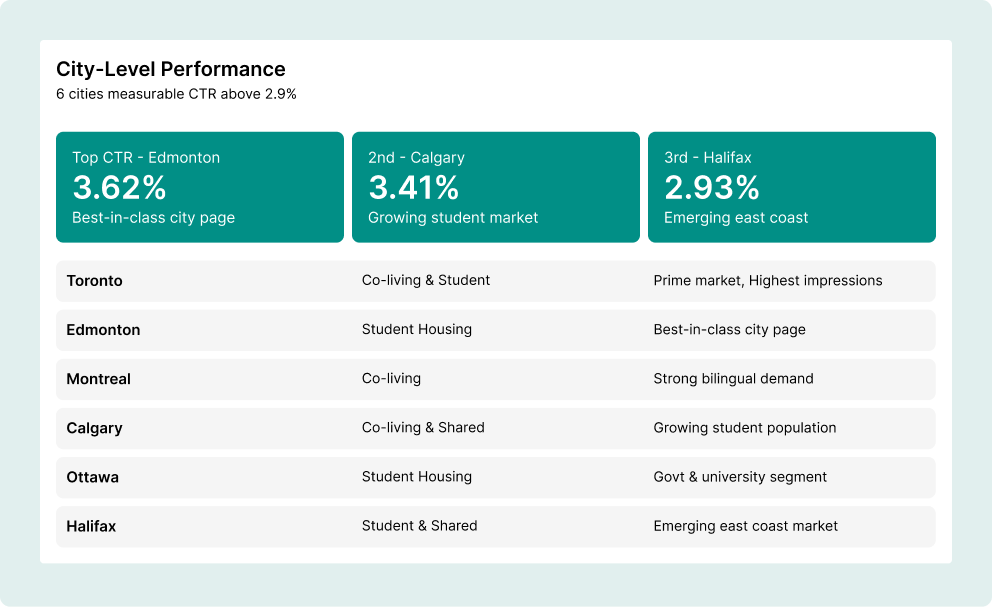
Harrington Housing is a fast-growing coliving and student housing marketplace serving major Canadian cities – Toronto, Edmonton, Montreal, Calgary, Ottawa, and Halifax – with a growing presence in the USA and internationally. The platform connects students and young professionals with fully furnished, flexible-lease co-living rooms, offering a modern, all-inclusive alternative to traditional rental contracts.
Founded on the belief that shared living should be simple, affordable, and community-driven, Harrington Housing has grown rapidly by targeting Canada’s large and mobile student population – the country enrolls over one million international students annually, the majority of whom require furnished, short-term accommodation close to universities and city centres.
As the property portfolio expanded across six cities and the tenant base grew into the thousands, it became clear that Harrington’s existing infrastructure – a combination of spreadsheets, email threads, and disconnected third-party tools – could no longer support the operational demands of a scaling multi-city platform. The leadership team recognised that to maintain service quality, support continued growth, and compete with institutional players in the PropTech space, they needed a purpose-built digital backbone.
The Canadian Coliving Market Context
Canada’s coliving market is structurally different from the US and UK equivalents. Demand is concentrated in specific university cities, driven almost entirely by two annual intake cycles – September (the primary intake) and January (the winter semester). This creates sharp, predictable demand spikes that a well-designed platform can capture at scale, provided the property discovery and booking experience is frictionless.
Toronto, Montreal, and Vancouver dominate rental demand, but Edmonton, Calgary, Ottawa, and Halifax represent fast-growing markets as regional universities expand international enrolment. Harrington Housing’s strategy – building city-specific supply and a platform that serves each market’s distinct search behaviour – positioned it to capture demand that national players were unable to address with generic listings.
The opportunity was clear: a platform that could handle the entire tenant journey digitally – from room search and verification to lease signing and rent collection – would give Harrington a decisive operational and experiential advantage over competitors still relying on manual processes.
Why a Custom Platform — Not Off-the-Shelf
The team evaluated several off-the-shelf property management solutions before engaging Noseberry Digitals. Each fell short for the same reason: they were built for traditional landlords managing long-term residential tenancies, not for a co-living marketplace operating across multiple cities with short- to medium-term lease terms, multi-currency payments, international tenant verification, and a community-first brand experience.
A custom build was the only path to deliver the combination of tenant self-service, automated payments, document verification, city-level content management, and modular architecture needed to support Harrington’s growth roadmap, including mobile apps, AI-driven pricing, and IoT integration planned for Phase 2 and beyond.
The Challenges
As Harrington Housing expanded its portfolio across six Canadian cities, the operational cracks became impossible to ignore. What had worked as a small startup – spreadsheets, email, ad-hoc tools – had become a liability at scale. Four compounding challenges were identified as the critical obstacles to sustainable growth:
Fragmented Operations Across Six Canadian Cities
Each city was its own operational island. Property data, tenant records, maintenance logs, and financial information were held in separate files and systems per city, making it nearly impossible to get a consolidated view of the business. As the team grew, version control issues, duplicate records, and missed communications became daily occurrences.
- No single source of truth – staff worked from different versions of the same spreadsheets
- City managers had no visibility into other markets, preventing resource sharing
- Cross-city reporting required manual data consolidation, often taking days
- Rapid team growth amplified the data inconsistency problem exponentially
Entirely Manual Tenant Onboarding and Verification
The end-to-end tenant onboarding process – from application receipt to move-in – was handled through email chains, manually reviewed documents, and phone calls. Each onboarding took multiple days and required the direct involvement of at least two staff members. The process did not scale and created bottlenecks that left units vacant for longer than necessary.
- Document collection via email – no standardised submission workflow
- Manual ID and background verification took 2–5 business days per applicant
- Lease agreements drafted manually from templates – error-prone and slow
- No digital signature capability – physical or scanned signatures required
- Move-in scheduling is coordinated manually, with no system-of-record for unit availability
No Tenant Self-Service Portal or Automated Payment Infrastructure
Tenants had no online portal. Every interaction – paying rent, requesting maintenance, viewing a lease document, or asking a question – required a phone call or email. The support team was overwhelmed with low-value, repetitive enquiries that a self-service portal would eliminate. Rent was collected via bank transfer, with manual reconciliation and no automated reminders.
- 100% of rent payments processed manually – no online payment option
- Late payment rates were high, with no automated reminder system in place
- Maintenance requests tracked in a shared spreadsheet – easily overlooked
- Tenants had no visibility into their lease, payment history, or request status
- High support volume consumed staff time that should have been focused on growth
Zero Operational Visibility and Data-Driven Decision Making
Leadership had no real-time view of the business. Occupancy rates, rent arrears, maintenance backlogs, and city-level revenue performance were calculated retrospectively, often with week-old data. There was no dashboard. No live reporting. No ability to identify underperforming assets or spot emerging demand trends before they become problems.
- Occupancy tracking is done via weekly manual updates to shared spreadsheets
- Rent arrears are not visible until the month-end reconciliation
- No financial reporting by city, property, or tenancy type
- Expansion decisions are made on intuition rather than data
- No mechanism to identify high-value tenant segments or retention risks
The Objectives
Before Phase 1 development began, four strategic objectives were defined, scoped, and agreed upon with Harrington Housing’s leadership team. Each objective is mapped directly to one or more of the operational challenges identified in the discovery phase:
Unify All Operations Into a Single Multi-City Platform
Replace every spreadsheet, email workflow, and disconnected tool with one unified web platform covering the complete tenant lifecycle across all Canadian cities simultaneously. Every team member — regardless of city — should work from the same system, with role-appropriate access to the data and tools they need.
- Single centralised database for all tenant, property, and financial data
- City-specific views and workflows within a unified admin panel
- Real-time data consistency across all markets — no manual syncing
- Scalable to additional Canadian cities and international markets in future phases
Automate Tenant Onboarding from Application to Move-In
Reduce the tenant onboarding timeline from multiple days to under one hour by digitising every step of the process. Applicants should be able to apply, submit documents, receive verification, sign a lease, and schedule a move-in entirely within the platform — with no email or phone interaction required for standard cases.
- Online application portal with standardised document upload
- Automated ID, background, and rent history verification via Boom API
- Digital lease generation and e-signature within the platform
- Automated move-in scheduling tied to live unit availability
- Staff alerted only for exceptions — standard cases handled end-to-end by the system
Launch a Tenant Self-Service Portal with Integrated Automated Payments
Give every Harrington tenant a personal portal providing 24/7 access to their lease, payment history, maintenance requests, and direct communication with the Harrington team. Integrate Stripe and GoCardless for automated rent collection, with recurring payment setup, smart reminders, and real-time payment visibility for property managers.
- Tenant portal accessible via web browser – mobile-optimised
- Stripe integration for card payments (international tenants)
- GoCardless integration for direct bank debit (UK and Canadian tenants)
- Automated rent reminders and late fee application per Harrington policy
- Maintenance ticketing system with status tracking and resolution notifications
Build a Real-Time Operations and Financial Reporting Dashboard
Deliver an admin dashboard that gives Harrington’s leadership and city managers live visibility into occupancy, rent collection, arrears, maintenance backlog, and city-level revenue performance. The data should be available in real time – not retrospectively – and presented in a format that supports fast, confident operational decisions
- Live occupancy rates by city, property, and unit type
- Real-time rent collection status and arrears tracking
- Cash flow projections based on current occupancy and upcoming renewals
- City-level and portfolio-level P&L reporting
- Exportable reports for board reporting and investor updates
The Solution
Noseberry Digitals designed and engineered a full-stack, custom co-living and property management platform tailored to Harrington Housing’s exact operational requirements. The platform was developed iteratively over six months in agile sprints, with bi-weekly review sessions with the Harrington team ensuring the build stayed tightly aligned to real-world workflows.
The architecture is modular by design — each feature module (bookings, payments, verification, reporting) operates independently through a shared database and authentication layer. This keeps the platform maintainable, testable, and extensible for the Phase 2 features already planned: a mobile app, an AI-driven pricing engine, and IoT smart-lock integration.
Platform Architecture Overview
The platform is structured around three access layers — Public (prospective tenants browsing properties), Tenant (authenticated portal for active tenants), and Admin (property managers, city managers, and leadership). All three layers share a single data layer, ensuring consistency across every user interaction without data duplication or manual syncing.
Role-based access control governs every admin action. Accountants can view financial data but cannot modify property listings. City managers can manage maintenance tickets for their assigned portfolio but cannot access another city’s financial reports. Administrators have full access with an audit trail of all actions. This granular permissions model enables collaborative use of the platform across Harrington’s distributed team without compromising data integrity or security.
WS 1 · Booking and Property Discovery
The platform’s first touchpoint for prospective tenants is a fully functional room search and booking module. Tenants can filter available rooms by city, price range, move-in date, and room type. Real-time availability prevents double-booking. The system supports flexible lease terms, promotional pricing, and tour scheduling — all managed from the admin panel without developer involvement.
- Room Search & Filtering: City, price, availability, room type, amenities — all filterable in real time
- Tour Scheduling: Prospective tenants book property viewings directly; managers receive instant notifications
- Flexible Lease Terms: Property managers configure minimum/maximum lease durations and promotional offers per listing
- Real-Time Availability: Unit availability updates instantly on booking or cancellation — zero double-booking risk
- Mobile-Optimised Discovery: Full search and booking experience accessible on any device, screen size, or browser
WS 2 · Tenant Onboarding and Document Verification
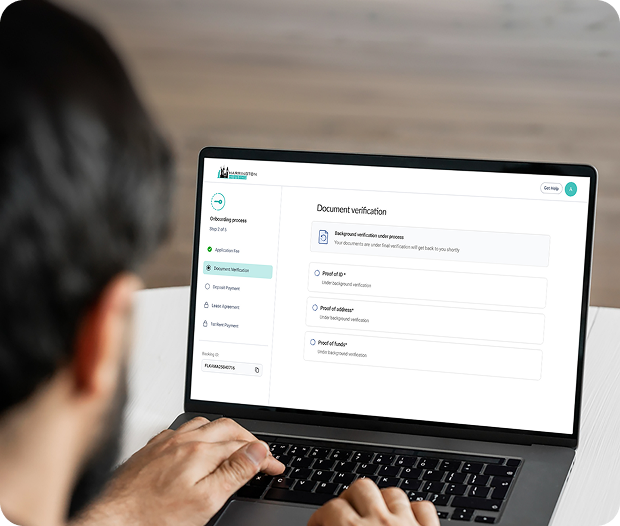
The onboarding module digitises the entire pre-tenancy process. From the moment an applicant submits their details, the system guides them through document upload, triggers automated verification via Boom’s API, generates a digital lease, and sends it for e-signature – all without staff intervention for standard cases.
- Standardised Application Portal: Structured application form with required document upload – no email attachments
- Boom API Verification: Automated ID checks, background screening, and rent history reports triggered on submission
- Digital Lease Generation: Lease agreements auto-populated with tenant and property data – no manual drafting
- E-Signature Integration: Tenants sign digitally within the portal; countersignature by the property manager in the admin panel
- Verification Status Tracking: Managers see live status of every pending verification – flags exceptions immediately
- Move-In Checklist Workflow: Digital move-in checklist generated on lease sign, with photo upload and condition logging
WS 3 · Payment Automation and Rent Collection
The payment module is the platform’s highest-impact operational component. It replaced entirely manual bank-transfer-based rent collection with a fully automated system supporting card payments and direct debit, with recurring payment setup, intelligent reminders, automatic late fee application, and real-time arrears tracking.
- Stripe Integration: Card payment processing for international tenants – PCI-compliant, 150+ currency support
- GoCardless Integration: Direct bank debit for UK and Canadian tenants – automatic recurring rent collection
- Recurring Payment Setup: Tenants configure monthly auto-pay at onboarding – removes payment friction entirely
- Automated Reminders: Smart reminder sequence sent 7 days, 3 days, and 1 day before the rent due date
- Late Fee Automation: Configurable late fee rules applied automatically per Harrington’s policy – no manual override needed
- Rent Arrears Dashboard: Real-time view of every outstanding payment, days overdue, and contact history per tenant
- Payment History Portal: Tenants view full payment history, download receipts, and manage payment methods from their portal
WS 4 · Tenant Self-Service Portal Every Harrington tenant has a personalised portal providing 24/7 access to everything they need without calling or emailing the team. The portal covers the full tenancy lifecycle from lease signing and rent payment to maintenance requests and move-out coordination.
- Lease Viewer: Tenants access their live lease document, key dates, and renewal options at any time
- Payment Centre: Pay rent, set up direct debit, view payment history, download receipts all in one place
- Maintenance Tickets: Raise a maintenance request in under 60 seconds with photo upload and issue categorisation
- Ticket Tracking: Real-time status updates on every open ticket tenant always knows where their request stands
- Direct Messaging: Structured in-portal messaging with Harrington’s team no email threads, full conversation history
- Document Hub: All tenancy documents (lease, ID verification, move-in checklist) accessible and downloadable
Move-Out Coordination: Tenants initiate move-out requests, schedule inspections, and track deposit return status
WS 5 · Maintenance and Ticketing System
The maintenance module connects tenants, property managers, and maintenance vendors in a single workflow. Requests raised by tenants in the portal are automatically routed to the correct property manager based on city and property assignment. Managers can prioritise, assign to vendors, and track resolution – with full audit trail per unit.
- Automatic Routing: Tickets are routed to the assigned property manager on creation, with no manual triage
- Vendor Assignment: Managers assign tickets to internal staff or external vendors directly from the admin panel
- Priority Tiers: Urgent, standard, and scheduled priority levels with configurable SLA targets
- Resolution Tracking: Status updates (open, in-progress, resolved) visible to both tenant and manager in real time
- Maintenance History: Full maintenance history stored per unit – visible to incoming tenants and for compliance audits
- Cost Logging: Maintenance costs logged against each ticket for property-level expense reporting
WS 6 · Financial Reporting and Admin Dashboard
The admin dashboard transforms Harrington Housing’s operational data into a strategic asset. Leadership and city managers access live reporting on every metric that matters — occupancy, revenue, arrears, maintenance costs, and tenant retention — without opening a spreadsheet.
- Live Occupancy Dashboard: Real-time occupancy rates by city, property, unit type, and lease term
- Revenue Reporting: Rental income by city and portfolio, with month-over-month and year-over-year trend analysis
- Cash Flow Projections: Forward-looking cash flow based on current occupancy and upcoming lease renewals
- Arrears & Collections: Outstanding rent, late fees collected, and collection rate by city and property manager
- Maintenance Cost Tracking: Expense logging against properties for accurate P&L reporting
- Tenant Retention Analytics: Renewal rates, churn by city, and average tenancy duration — key inputs for expansion planning
- Exportable Reports: One-click export to CSV/Excel for board reporting and investor updates
WS 7 · CMS, Webhooks, and Third-Party Integrations
The platform includes a fully functional content management system for Harrington’s marketing team, webhook endpoints for real-time property listing distribution to partner platforms, and deep integrations with Zoho for CRM and accounting synchronisation.
- Built-in CMS: Marketing team updates property listings, adds city pages, edits FAQs, and publishes blog content without developer support
- Webhook Distribution: Third-party platforms access Harrington’s live inventory via webhooks — expanding reach without manual data sharing
- Zoho CRM Sync: Tenant application data and contact records sync automatically to Zoho CRM
- Zoho Desk Integration: Support tickets raised in Harrington’s portal can escalate to Zoho Desk for complex case management
- Accounting Sync: Invoice and payment data flows to accounting tools — eliminating duplicate data entry for the finance team
- User Access Management: Granular role-based access controls across all admin functions — full audit trail of every action
The Impact
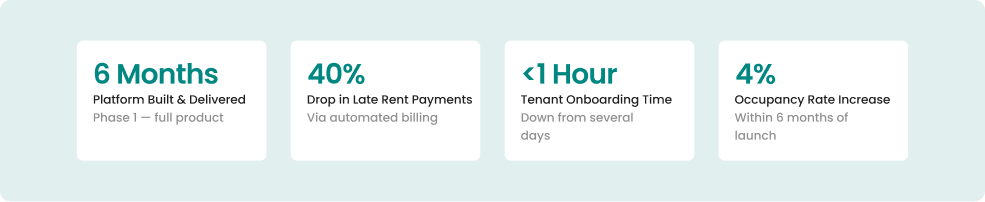
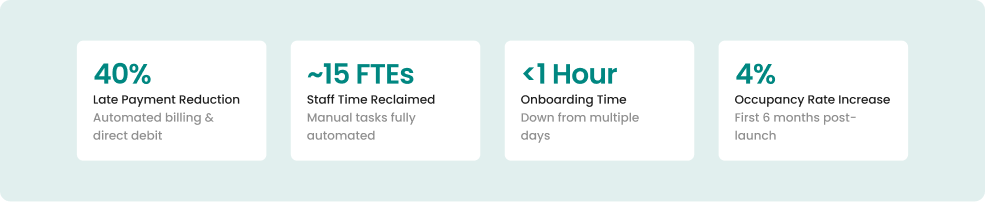
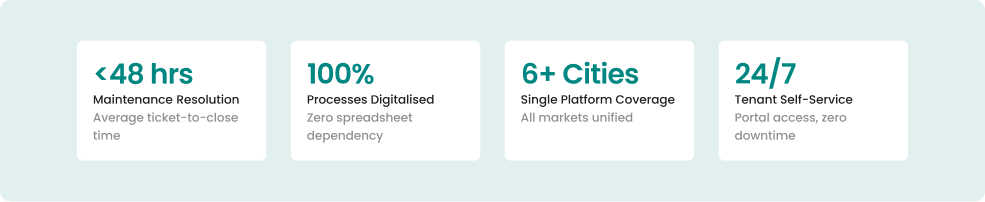
The custom platform delivered measurable, documented results across every dimension of Harrington Housing’s operations within six months of launch. Below are the key outcomes – measured against the baseline established during the pre-build discovery phase.
Performance Summary
Impact by Area
1- Operational Efficiency
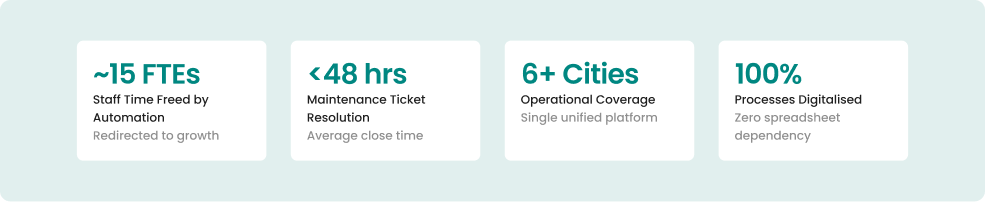
The platform’s automation layer replaced the manual workload previously equivalent to approximately 15 full-time employees. Rent invoicing, payment reminders, late fee application, document verification, lease generation, and maintenance routing all run with minimal human intervention. The operations team – freed from repetitive administrative tasks – redirected their capacity to tenant relationship management, portfolio expansion, and service quality improvement. This reallocation of human capital was one of the most significant business outcomes of the project.
2- Faster Tenant Onboarding
The onboarding timeline collapsed from multiple days of back-and-forth email to under one hour for standard applicants. ID verification, background checks, and rent history reports through Boom’s API are completed automatically within minutes of submission. Digital lease generation and e-signature mean a tenant can go from application to signed lease without a single phone call. Units are filled faster. Revenue gaps between tenancies are minimised. The team’s time is no longer consumed by document chasing.
3. Rent Collection and Cash Flow
The combination of Stripe, GoCardless, automated reminders, and direct debit recurring payments drove a 40% reduction in late payments within the first three months. Property managers now have a real-time arrears dashboard rather than a monthly reconciliation spreadsheet – enabling them to identify and address payment issues before they escalate. Cash flow has become more predictable, which has had a direct positive impact on Harrington’s ability to plan and invest in new properties.
4. Occupancy and Revenue
Streamlined booking, faster onboarding, and an improved tenant experience translated directly into a 4% increase in occupancy across the portfolio within the first six months. This improvement is compounding: higher occupancy drives higher revenue, which funds further portfolio expansion, which drives platform usage, which generates more data for optimisation. The platform did not just improve current operations – it created a growth flywheel that manual processes could never have enabled.
5. Tenant Satisfaction and Retention
The tenant portal fundamentally changed the tenant experience. Renters can now pay rent, submit maintenance requests, view their lease, and communicate with Harrington’s team without ever making a phone call or sending an email. Maintenance ticket resolution under 48 hours became the new standard – down from an average of several days when managed via shared spreadsheets. Higher satisfaction has translated into stronger renewal rates, lower voluntary churn, and increased referral traffic – all of which reduce the cost of tenant acquisition over time.
6. Data Visibility and Strategic Decision-Making
Perhaps the most underappreciated impact of the platform is the shift it enabled in how Harrington’s leadership makes decisions. Real-time occupancy dashboards, city-level revenue reporting, and forward-looking cash flow projections replaced gut instinct and delayed spreadsheet analysis. Management can now identify underperforming assets, spot demand trends by city, and model the financial impact of expansion decisions before committing capital. The platform turned operational data into a strategic asset.
City-Level Performance Overview
What the Numbers Mean for Phase 2
The Phase 1 platform has established a data-rich operational foundation that makes every Phase 2 investment more targeted and higher-return. AI-driven pricing can be trained on real occupancy and payment data. Mobile app development can be prioritised based on actual tenant device usage patterns. IoT smart-lock integration can be rolled out to the highest-traffic properties first. The modular architecture means each Phase 2 feature slots into the existing system without rebuilding the core – compressing the timeline and cost of every future enhancement.