-
Services
Services
Offerings
Learn moreSaaS Development

Web Application Development
Native & Cross-Platform Mobile Apps
Enterprise Software Solutions
API Architecture & Integration
Legacy System Modernization

Time Tracking Web App: Streamlining Productivity with a Custom Enterprise SaaS Solution.
Read case study
Offerings
Learn moreUser Research & Persona Mapping
UX Strategy & Wireframing
UI Design Systems & Libraries
Micro-Interactions & Motion Design
Offerings
Learn moreData Pipeline Design & Development
ETL & Data Warehousing
BI Dashboards & Advanced Reporting
Data Visualization & Analytics
Data Migration & Integration Optimization
Offerings
Learn moreMarketing & Sales Automation
Performance Marketing
Email & WhatsApp Campaigns
SEO & Content Strategy
Analytics & Conversions
CRM Implementation & Integration
Offerings
Learn moreCloud Architecture Design
CI/CD Pipeline Automation
Container Orchestration & Microservices
Cloud Migration & Cost Optimization
AIOps-Powered Intelligence
Cloud Security & Compliance
Share your project details
Share your details with us, and we'll reach out to discuss your needs.
Enquire now
Offerings
Learn moreMachine Learning
Generative AI
Conversational AI & Virtual Agents
Computer Vision Applications
AI-Powered Process Automation
AI Strategy & Consulting
Share your project details
Share your details with us, and we'll reach out to discuss your needs.
Enquire now
- Company



 Services

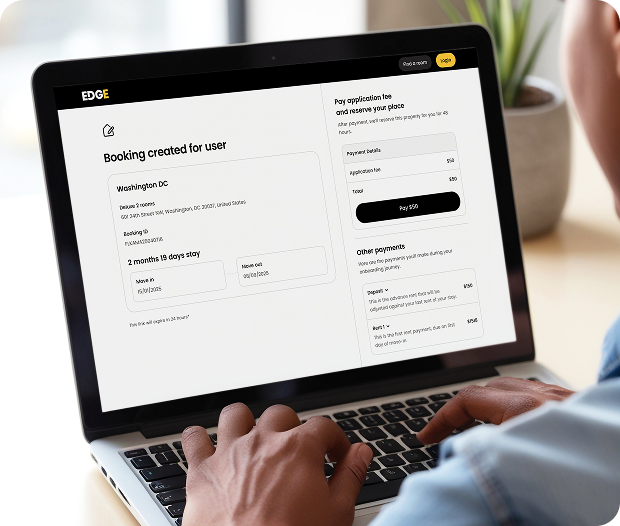
Scope of work
Web Application
Industry
Coliving
Project timeline
6 Month
Project goal
Inspired by our work?
Download the full case study.
Table of contents
More from Proptech and Real Estate
The Overview
About The Client
Edge Living is a Canadian co-living and furnished housing platform designed specifically for students, interns, and young professionals seeking move-in-ready rooms across major Canadian cities. Operating across Vancouver, Edmonton, and Victoria, Edge Living offers fully furnished rooms in secure, well-located buildings – with flexible leases, all-inclusive pricing, and a community-first living experience that eliminates the friction of traditional renting.
The Edge Living model is built on a core promise: no hauling furniture, no negotiating with flaky landlords, no surprise utility bills. Just a room that is ready to live in from day one, designed for the life the tenant is building. This proposition resonates powerfully with international students, co-op placement students, and new professionals relocating to Canadian cities – a demographic that values speed, simplicity, and trust above all else.
As Edge Living scaled its property portfolio and tenant base across three cities, the gap between its brand promise and its operational reality became a liability. Manual workflows, disconnected tools, and the absence of a tenant-facing digital experience were creating friction at every stage of the journey – from the moment a prospective tenant searched for a room to the day they moved out.
The Buyer Intent Opportunity
Buyer Intent: The Gap Between Search and Signed Lease
Edge Living’s prospective tenants arrive with strong buyer intent – they have made a life decision (move to Vancouver, start an internship, begin a semester) and are actively looking for a room. The problem was that the platform had no mechanism to capture, qualify, and convert that intent. Students found Edge Living but hit a wall: no seamless booking flow, no instant availability confirmation, no digital lease path. High-intent visitors left without converting, and the ones who stayed had to navigate a slow, email-based onboarding process. The platform was built to close this gap – turning every high-intent visit into a frictionless path to a signed lease.
The Canadian Student Housing Market
Canada hosts over one million international students annually – the majority of whom require furnished, flexible, short-to-medium-term accommodation in proximity to universities and city transit. Vancouver, Edmonton, and Victoria are three of Canada’s most active student housing markets, with demand driven by UBC, UVic, the University of Alberta, NAIT, NorQuest College, and a cluster of private institutions catering to international enrolment.
This market has a distinct search and decision pattern: students typically search 60–90 days before their intended move-in date, compare options heavily on price and proximity, and make final decisions based on trust signals – reviews, transparent pricing, clear move-in processes, and responsive communication. A platform that could deliver all of these touchpoints digitally – and convert that intent into a booking within minutes – would have a decisive competitive advantage over operators still relying on email enquiries and manual coordination.
Edge Living’s brand promise – no friction, no surprises, move in and breathe – needed a digital platform that delivered that same frictionless experience from the first Google search to the first night in the room. Noseberry Digitals built that platform.
The Challenges
Edge Living’s operational challenges were not unique to its business — they are the same challenges every co-living operator faces as it scales beyond what spreadsheets can handle. What made them urgent for Edge Living was the mismatch between its consumer-facing brand promise (simple, frictionless, trust-first living) and the manual, fragmented reality of its back-end operations.
1- No Digital Path to Convert Buyer Intent Into a Signed Lease
Edge Living’s prospective tenants arrived at the website with clear, high purchase intent – they had already decided to move, they had a target city, and they wanted to book quickly. The platform had no booking module. There was no way to check live availability, no way to initiate a lease online, and no way to pay a deposit or holding fee digitally. High-intent visitors who could not complete a booking in the same session were lost – often to competitors with a faster online path.
- No real-time room availability – prospective tenants had to email to enquire
- No online booking, deposit payment, or holding fee functionality
- No digital application form – enquiries arrived via email with inconsistent information
- High drop-off at the point of decision because the next step was unclear or too slow
- The sales team spent time manually processing enquiries that should have converted automatically
2- Entirely Manual Tenant Onboarding Across Three Cities
Once a prospective tenant expressed interest, the onboarding process – document collection, identity verification, lease drafting, and move-in coordination – was handled entirely by hand across email and phone. Each onboarding took 2–4 business days, required multiple staff touchpoints, and created inconsistent experiences between cities. There was no standardised process, no audit trail, and no mechanism to track where each applicant was in the pipeline.
- Document requests sent via email – no structured submission portal
- ID and background verification performed manually – 2–4 days per applicant
- Lease agreements drafted individually from Word templates – slow and error-prone
- No digital signature – physical or scanned leases required before move-in
- Move-in coordination handled via phone – no system of record for unit availability or keys
3- No Tenant Portal – Every Post-Move-In Interaction Was Manual
After move-in, tenants had no self-service access to anything. Rent was paid by bank transfer with manual reconciliation. Maintenance requests were submitted by text or email and tracked in a shared spreadsheet. Lease documents were sent as PDF attachments. Receipts were issued manually on request. Every routine interaction consumed staff time that should have been spent on retention and growth – and the experience was well below the standard tenants expected from a modern co-living brand.
- Rent collected via bank transfer – manual reconciliation, high error rate
- No automated rent reminders – late payments chased reactively by phone
- Maintenance requests tracked in a shared spreadsheet – frequently missed or delayed
- Tenants had no visibility into their lease terms, payment history, or request status
- High inbound contact volume for tasks that a self-service portal would eliminate
4- Three Cities Operating as Three Separate Islands
Vancouver, Edmonton, and Victoria each operated with their own files, their own processes, and their own informal systems. There was no consolidated view of the portfolio, no cross-city reporting, and no ability to share learnings or resources between markets. Leadership made decisions based on incomplete data. Expansion into new cities was blocked by the inability to replicate and standardise what was working – because nothing was documented or systematised.
- No unified property database – city managers maintained separate spreadsheets
- No portfolio-level occupancy or revenue reporting
- Expansion plans were delayed because the existing model could not be systematically replicated
- Staff onboarding in each city required learning informal local processes from scratch
- No cross-city visibility for leadership – every update required manual collection from city managers
The Conversion Problem in Numbers
In the Canadian co-living market, the average student researching housing makes 6–10 online visits before booking. If a platform cannot complete the booking journey online – with live availability, instant confirmation, and a clear next step – it loses that tenant to a competitor that can. Edge Living was generating strong awareness but converting a fraction of the demand it was capturing. The platform was built to close that conversion gap.
The Objectives
Four strategic objectives were defined and agreed upon with Edge Living’s leadership before Phase 1 development began. Each objective mapped directly to a specific operational failure identified during the discovery process:
Build a Digital Booking Engine That Captures and Converts Buyer Intent
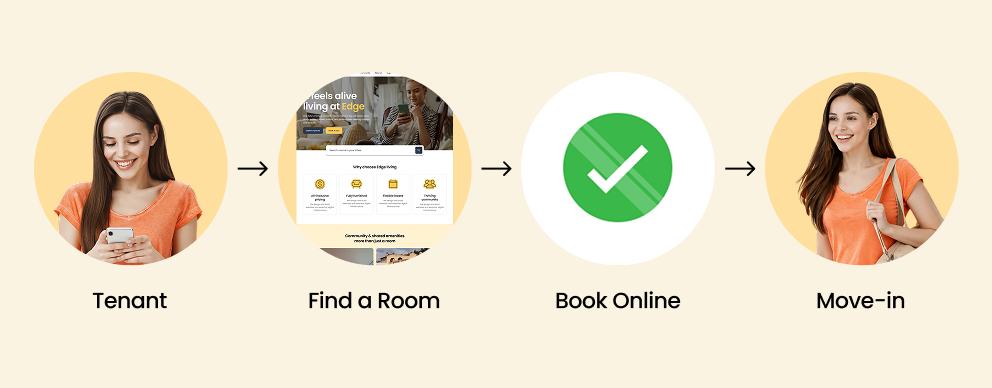
Create a seamless online booking journey – from room discovery to application, deposit payment, and lease initiation – that a prospective tenant can complete entirely within the platform, without emailing or calling. Every high-intent visitor should have a clear, frictionless path from search to signed lease.
- Real-time room availability across all three cities – no email enquiry required
- Online application form with standardised field collection
- Digital deposit and holding fee payment via Stripe
- Booking confirmation within minutes – not days
- Automated lead capture and follow-up for incomplete applications
Automate Tenant Onboarding from Application to Move-In
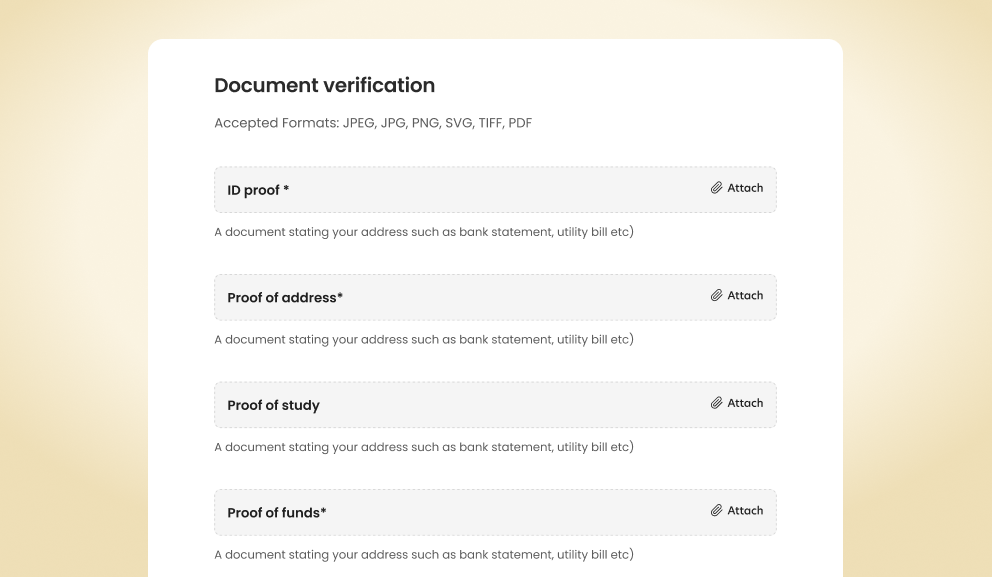
Reduce the average onboarding timeline from 2–4 days to under one hour by digitising every step – document submission, identity and background verification via Boom API, digital lease generation, e-signature, and move-in scheduling – all within the platform, with no manual staff intervention required for standard applicants.
- Structured document upload portal – no email attachments
- Automated ID and background verification via Boom API – minutes, not days
- Digital lease generation populated automatically from application data
- E-signature in-portal – no printing, scanning, or PDFs by email
- Automated move-in scheduling tied to live unit availability and the city coordinator
Launch a Tenant Self-Service Portal with Automated Payment Infrastructure
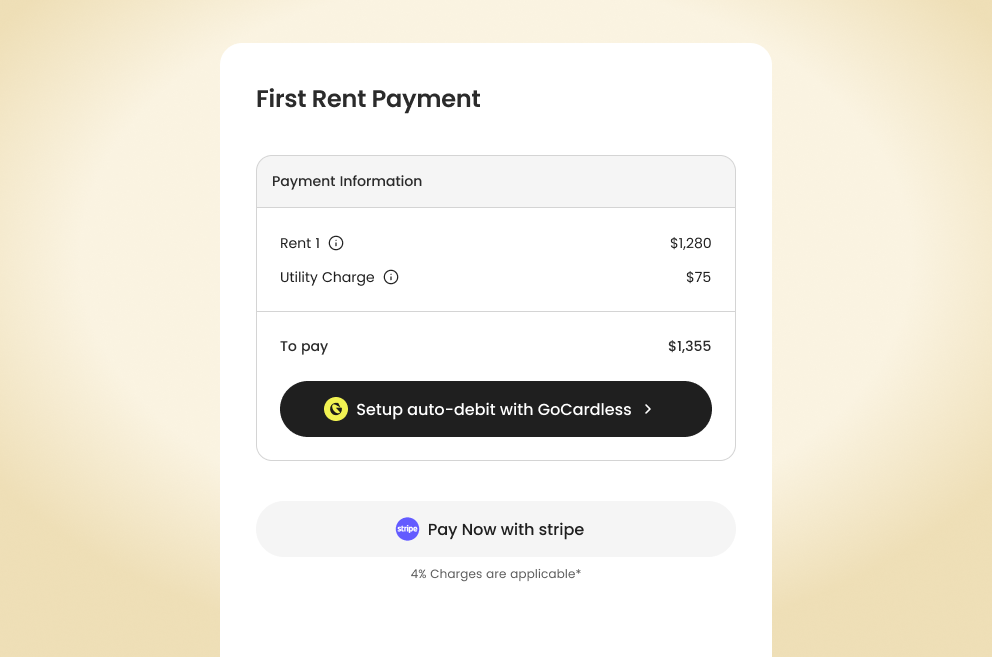
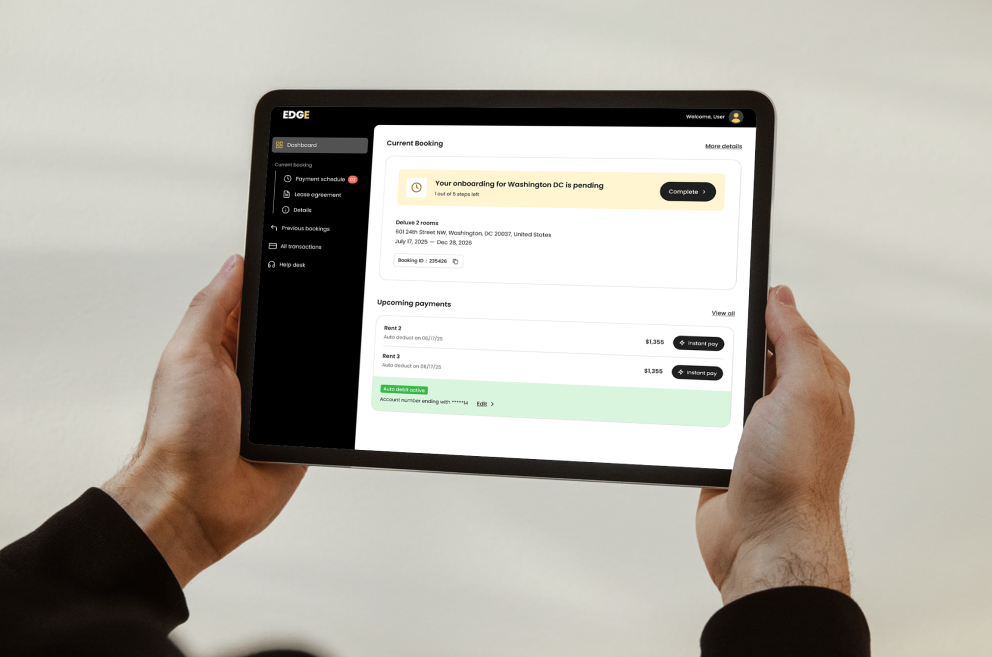
Give every Edge Living tenant a 24/7 personal portal covering rent payment, maintenance requests, lease access, and direct communication with the team. Integrate Stripe and GoCardless for automated rent collection – with recurring payment setup, intelligent reminders, and real-time payment visibility for property managers.
- Tenant portal accessible on any device – web-first, mobile-optimised
- Stripe for card payments – international and one-off transactions
- GoCardless for direct bank debit – recurring monthly rent automation
- Smart reminder sequence before each due date – reducing late payments
- Maintenance ticketing with real-time status tracking for tenants and managers
Unify All Three Cities Into a Single Platform with Live Reporting
Replace all city-specific spreadsheets, files, and informal processes with one unified platform – giving leadership real-time visibility into occupancy, rent collection, arrears, maintenance, and revenue across Vancouver, Edmonton, and Victoria simultaneously.
- Single admin panel covering all three cities with role-based city manager access
- Live occupancy dashboard by city, property, and unit type
- Real-time rent arrears and collections tracking
- Cash flow projections and city-level P&L reporting
- Expandable architecture – new cities added without platform rebuild
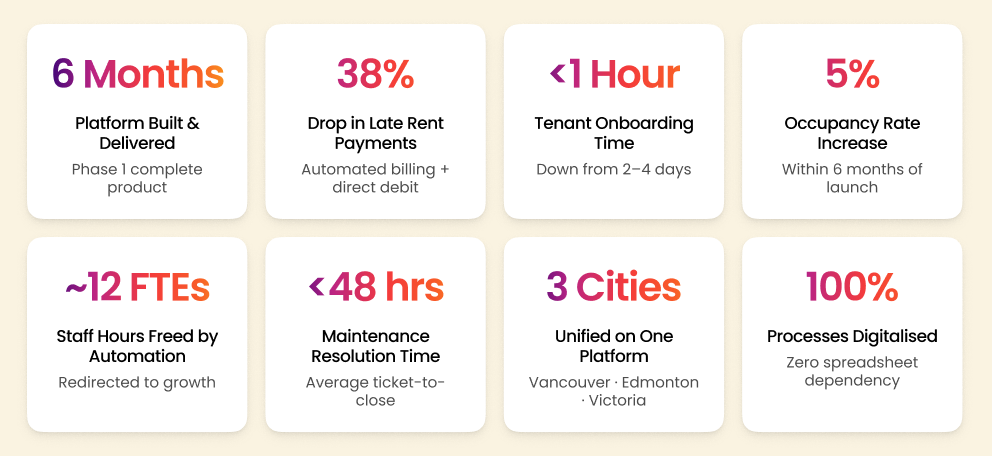
Objectives Met: All four objectives were delivered within the Phase 1 timeline. The booking engine went live across three cities with real-time availability, onboarding dropped to under one hour, automated payments drove a 38% reduction in late rent, and leadership gained a live cross-city dashboard for the first time
The Solution
Noseberry Digitals designed and built a full-stack, custom co-living and property management platform tailored to Edge Living’s operational structure and buyer-journey requirements. The platform was developed in agile sprints across six months, with regular review sessions ensuring the build matched the operational reality of Edge Living’s three-city team.
The architecture is modular and city-agnostic – each workstream (booking, onboarding, payments, portal, reporting) operates as an independent module through a shared database and authentication system. This keeps the platform maintainable and extensible: new cities, new features, and new integrations can be added in future phases without rebuilding the core.
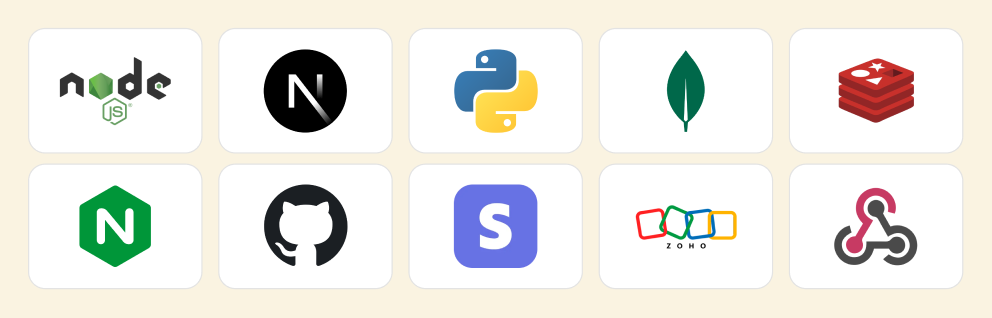
Technology Stack
Buyer Intent Architecture – How the Platform Converts Visitors Into Tenants
The platform was architected around the buyer journey – mapping every stage of the prospective tenant’s decision process to a digital touchpoint that reduces friction and increases conversion. This is not a standard property listing website. It is a conversion engine designed to take a student who just Googled ‘furnished room Vancouver’ and guide them to a signed lease within the same session.
The Impact
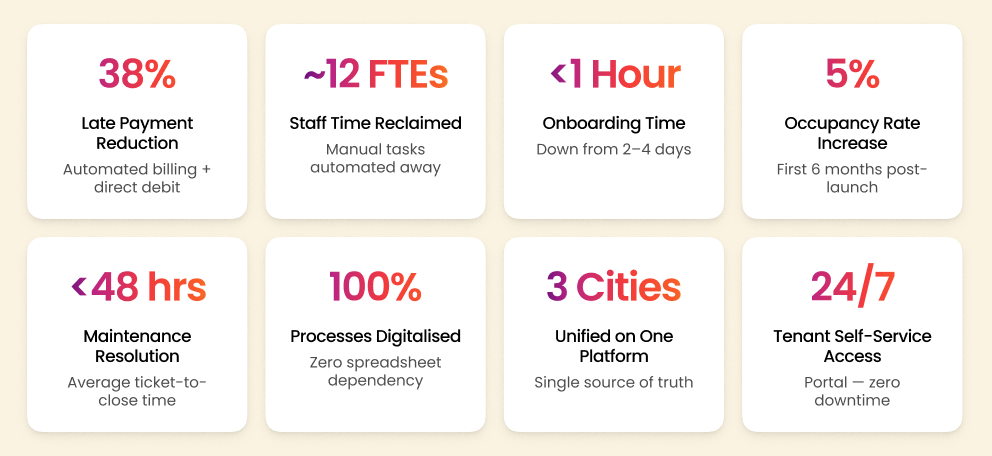
The following results were measured across the first six months following the platform launch. Every metric represents a direct improvement on the baseline established during the discovery phase – from operational efficiency and revenue performance to tenant satisfaction and conversion rate.
Buyer Intent and Conversion Impact
Conversion Rate Improvement
The introduction of real-time availability, an online booking flow, and instant deposit payment transformed Edge Living’s website from a brochure into a conversion engine. Prospective tenants with high buyer intent – students who had already decided to move and were comparing options – could now complete a booking in the same session rather than waiting 24-48 hours for an email response. Room enquiry-to-application conversion improved significantly, and the average time from first visit to signed lease dropped from over a week to under 24 hours for standard applicants.
Impact by Area
1. Operational Efficiency
Automating the manual tasks previously performed by the equivalent of 12 full-time employees freed Edge Living’s team to focus on what drives revenue: tenant relationships, property acquisition, and community-building. Rent invoicing, payment reminders, document verification, lease generation, and maintenance routing all run with minimal human intervention. The operations team’s time allocation shifted dramatically from administration to growth.
2. Buyer’s Intent to Sign Lease
Before the platform, high-intent prospective tenants who could not get an immediate answer on availability or next steps frequently dropped off and chose a competitor. The booking engine – with live availability, online deposit payment, and instant application confirmation – eliminated the waiting period that caused drop-off. The platform converted intent into commitment within the same session, a capability Edge Living had never had before.
3. Faster Tenant Onboarding
The onboarding timeline fell from 2–4 business days to under one hour for standard applicants. Document submission, Boom API verification, digital lease generation, and e-signature are now complete in a single continuous workflow within the platform. Units are filled faster. Revenue gaps between tenancies shorten. The onboarding experience now reflects Edge Living’s brand promise – simple, fast, and trustworthy from the first interaction.
4. Rent Collection and Cash Flow
Stripe and GoCardless integrations, combined with automated reminder sequences and direct debit recurring payments, produced a 38% reduction in late payments within three months of launch. Property managers now have real-time arrears visibility rather than a delayed monthly reconciliation – enabling proactive resolution before arrears escalate. Cash flow has become more predictable, directly improving Edge Living’s ability to plan investment in new properties.
5. Occupancy and Revenue Growth
A 5% increase in occupancy across the portfolio within six months of launch represents meaningful revenue growth at scale. The improvement was driven by two factors: faster onboarding, filling units more quickly between tenancies, and improved tenant satisfaction, reducing voluntary churn. The platform also created an automated re-engagement mechanism for prospective tenants who had applied but not completed – recovering rooms that would previously have gone unoccupied.
6. Tenant Satisfaction and Retention
Edge Living’s tenant reviews consistently cite the same things: responsive team, beautiful spaces, and a hassle-free experience. The platform strengthened all three of these signals. The self-service portal eliminated the friction points that generated negative reviews – slow maintenance responses, confusing rent payment processes, and difficulty accessing lease documents. Maintenance resolution under 48 hours became the new standard. Tenant retention improved, referral rates increased, and the brand’s reputation for a genuinely frictionless co-living experience was reinforced at every interaction.
7. Cross-City Data Visibility
Leadership gained a real-time cross-city view of the portfolio for the first time. Occupancy trends, revenue per city, arrears by coordinator, and maintenance backlog by property became daily operational inputs rather than monthly retrospective summaries. Decisions on pricing, promotional offers, and expansion targets are now made with current data – not two-week-old spreadsheets.
City-Level Performance Overview
Phase 2 Roadmap
Phase 1 delivered the operational foundation. Phase 2 – planned for H1 2026 – will build on it with native iOS and Android mobile apps, an AI-driven pricing engine trained on Edge Living’s real occupancy and demand data, IoT smart-lock integration for fully digital move-in and move-out, and expansion into additional Canadian cities. The modular architecture ensures each Phase 2 component slots into the existing system without disrupting what is already working.