-
Services
Services
Offerings
Learn moreSaaS Development

Web Application Development
Native & Cross-Platform Mobile Apps
Enterprise Software Solutions
API Architecture & Integration
Legacy System Modernization

Time Tracking Web App: Streamlining Productivity with a Custom Enterprise SaaS Solution.
Read case study
Offerings
Learn moreUser Research & Persona Mapping
UX Strategy & Wireframing
UI Design Systems & Libraries
Micro-Interactions & Motion Design
Offerings
Learn moreData Pipeline Design & Development
ETL & Data Warehousing
BI Dashboards & Advanced Reporting
Data Visualization & Analytics
Data Migration & Integration Optimization
Offerings
Learn moreMarketing & Sales Automation
Performance Marketing
Email & WhatsApp Campaigns
SEO & Content Strategy
Analytics & Conversions
CRM Implementation & Integration
Offerings
Learn moreCloud Architecture Design
CI/CD Pipeline Automation
Container Orchestration & Microservices
Cloud Migration & Cost Optimization
AIOps-Powered Intelligence
Cloud Security & Compliance
Share your project details
Share your details with us, and we'll reach out to discuss your needs.
Enquire now
Offerings
Learn moreMachine Learning
Generative AI
Conversational AI & Virtual Agents
Computer Vision Applications
AI-Powered Process Automation
AI Strategy & Consulting
Share your project details
Share your details with us, and we'll reach out to discuss your needs.
Enquire now
- Company



 Services
Scope of work
Saas
Industry
IT
Project timeline
6 Months
Project goal
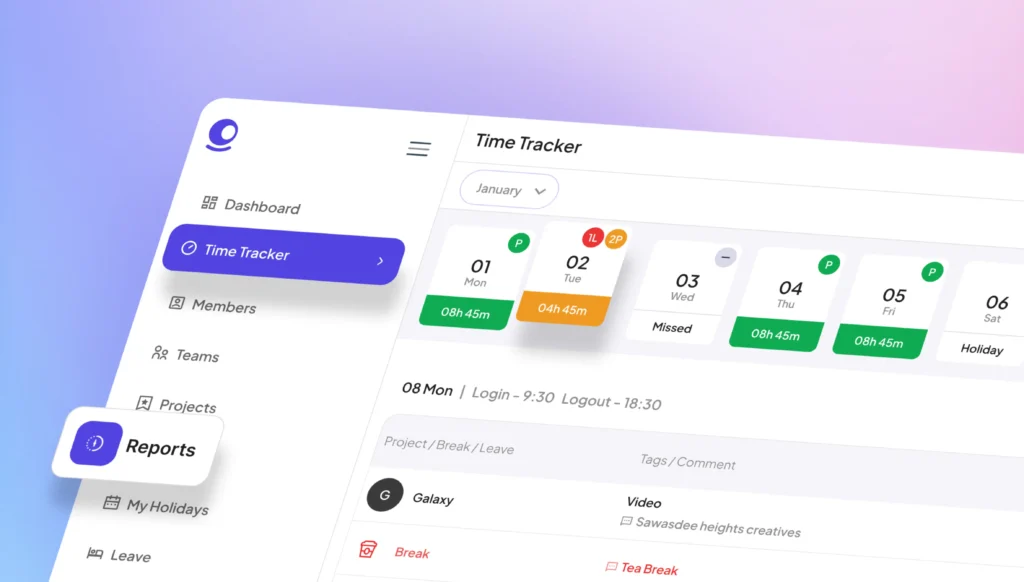
Implement a time tracking, reporting, and leave management solution to boost productivity and streamline approvals.
Since rollout, our team’s productivity has improved significantly, and leave and time management are fully organized. We’re now rolling this solution out for our other clients as well.

Team NBD
75%
faster task completion
100%
attendance tracking
Inspired by our work?
Download the full case study.
Table of contents
More from Other
The Overview
Nwatch was conceptualized as a strategic internal initiative to address growing operational inefficiencies in time tracking, reporting accuracy, and workforce management. What initially appeared to be a simple reporting gap soon revealed deeper structural challenges affecting productivity, accountability, and delivery timelines.
During a pre-project discussion for an upcoming client engagement, it became evident that the organization lacked a reliable system to generate structured, client-ready work reports. Without a standardized reporting mechanism, validating billable hours and demonstrating project progress posed a risk to transparency and client confidence.
However, as we analyzed internal workflows more closely, another issue surfaced: recurring delays in project deliveries. These delays were not caused by skill gaps but by the absence of visibility into work patterns, inconsistent tracking of productive hours, unregulated breaks, and fragmented leave management processes. What began as a reporting problem quickly evolved into a broader productivity and workforce governance challenge.
It became clear that the organization did not need just a reporting tool. It required a centralized, scalable operational system capable of:
- Accurately tracking daily work hours across teams
- Generating structured, client-ready productivity reports
- Providing real-time visibility into employee performance
- Regulating breaks and improving time discipline
- Streamlining leave applications and approval workflows
- Supporting role-based access for owners, managers, and employees
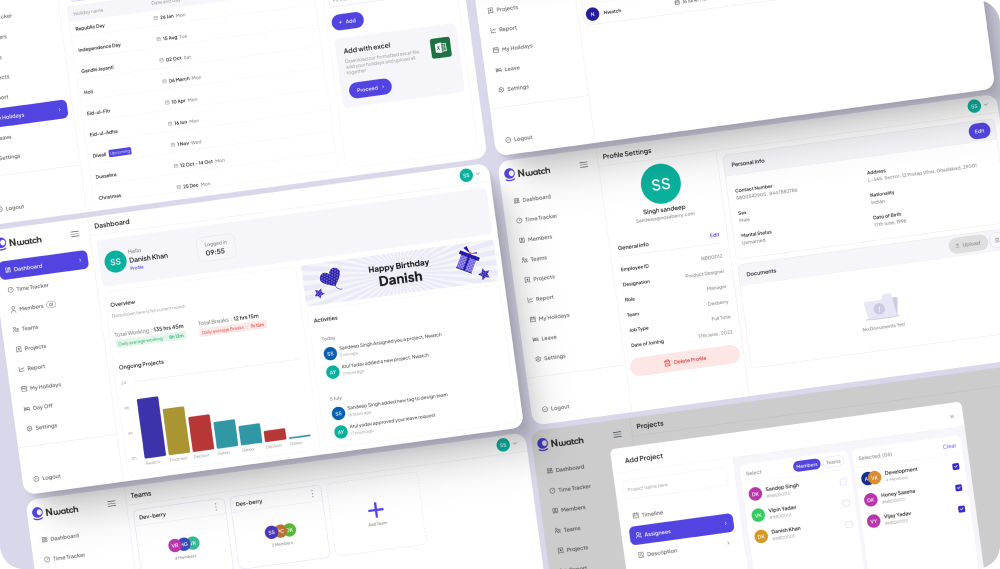
Nwatch was therefore designed as a full-fledged Enterprise SaaS platform built to create structure, improve accountability, and enable data-driven decision-making.
Rather than functioning as a basic time tracker, Nwatch became a modern workforce management solution that aligns operational transparency with productivity optimization. It bridges the gap between employee autonomy and organizational control, ensuring teams remain efficient while leadership gains actionable insights.
The result is not merely improved reporting but a structured, measurable, and scalable operational ecosystem for high-performing teams.
The Challenge
Before building Nwatch, several structural and operational inefficiencies were identified. These challenges were not isolated issues but interconnected gaps affecting reporting accuracy, productivity, and team coordination.
Absence of a Structured Reporting System
No Reliable Work Validation Mechanism
There was no centralized system to generate accurate, client-ready work reports. This created risks around billing transparency, project validation, and delivery tracking—especially for upcoming billable projects requiring documented progress.
Delayed Work Deliveries
Inconsistent Productivity Visibility
Project timelines were impacted due to inconsistent working hours and lack of structured monitoring. Without measurable data, identifying the root cause of delivery delays was difficult.
Unregulated Work Patterns
Frequent Breaks and Inconsistent Working Hours
Employees had flexibility in managing their time, but without a tracking mechanism:
- Breaks were frequent and unstructured
- Required daily working hours were not consistently met
- Focus time was reduced without visibility
This gradually impacted overall productivity.
Manual Leave Management System
Inefficient and Error-Prone Leave Handling
Leave applications were handled through emails and manual approvals, leading to:
- Overlapping absences
- Poor visibility into team availability
- Delays during urgent projects
There was no centralized dashboard to track leave data.
Lack of Employee Self-Assessment Tools
No Data-Driven Performance Awareness
Employees did not have access to performance insights that could help them understand their own productivity trends. Without visibility into time allocation, task distribution, and work patterns, optimization was difficult.
Scalability Constraints
No Unified Workforce Management System
As the team expanded, managing reporting, attendance, and leave through fragmented systems became unsustainable. The organization required a unified SaaS framework capable of supporting role-based access and future scaling.
Core Problem Statement
The fundamental challenge was not simply tracking time—it was creating a structured, scalable system that improves accountability, reporting transparency, and operational discipline without introducing unnecessary complexity.
The Objective
The development of Nwatch was guided by a clear strategic intent: to transform internal productivity management into a measurable, structured, and scalable operational system. Rather than building a simple time tracker, the objective was to create a unified SaaS platform that aligns employee performance, reporting accuracy, and managerial visibility under one centralized framework.
Establish Accurate Work Validation
One of the primary objectives was to create a reliable mechanism for tracking billable and non-billable hours. The organization required a system that could generate accurate, client-ready reports without manual intervention. By establishing structured time logging and standardized reporting, the platform aimed to eliminate discrepancies in work validation and ensure transparency in project delivery.
Improve Productivity Visibility
Recurring delivery delays highlighted the need for deeper visibility into daily work patterns. The objective was to help both employees and managers understand how time was being allocated across tasks, projects, and breaks. By enabling self-assessment and managerial oversight through structured dashboards, Nwatch aimed to foster accountability and improve overall productivity consistency.
Streamline Leave & Attendance Governance
Manual leave handling and inconsistent attendance monitoring were creating operational gaps. Another key objective was to digitize and automate leave workflows, introduce approval hierarchies, and provide real-time team visibility. This ensured better resource planning, minimized absentee conflicts, and supported smooth project execution.
Enable Data-Driven Decision Making
Beyond tracking, the goal was to empower leadership with actionable insights. Through performance analytics, filtered reports, and structured data exports, Nwatch was designed to support informed decision-making at both project and organizational levels. The objective was to move from assumption-based management to data-backed operational clarity.
Build a Scalable SaaS Foundation
The final objective was long-term scalability. Nwatch needed to function not only as an internal tool but as a product-ready SaaS solution capable of serving multiple teams and clients. This required a modular architecture, role-based access control, and a consistent design system that could support feature expansion without disrupting usability.
Together, these objectives positioned Nwatch as more than a productivity tool it became a structured operational backbone for modern teams seeking efficiency, transparency, and scalable growth.
The Solution
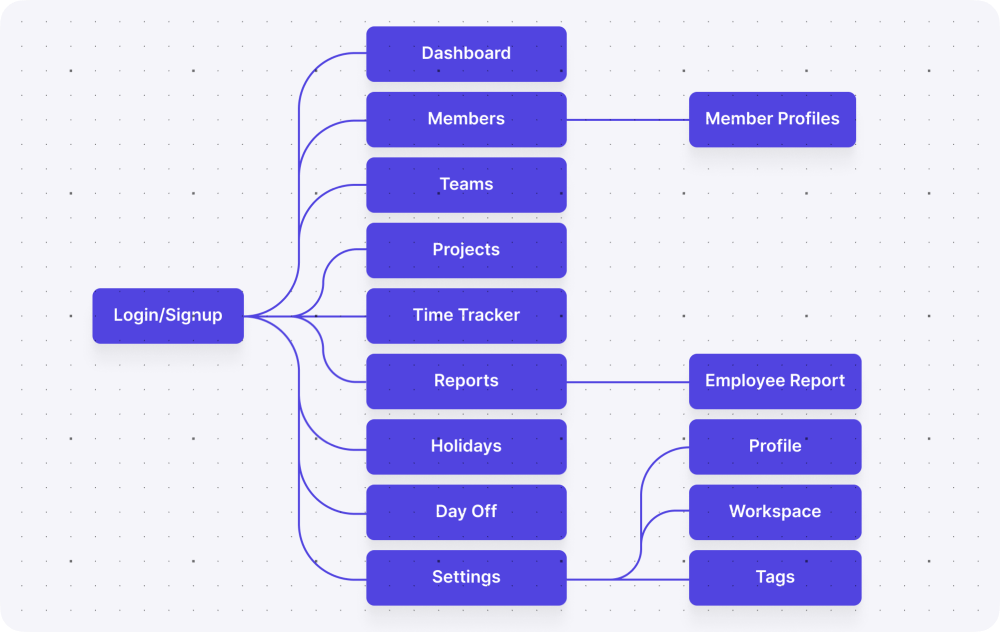
The solution was delivered as a structured, modular SaaS platform built around three core operational pillars: Time Tracking, Reporting Intelligence, and Leave Management, supported by scalable system architecture and a reusable design framework.
Rather than building isolated features, we designed Nwatch as an integrated operational control system. Each module feeds into the other, creating a unified ecosystem that improves workforce visibility, strengthens governance, and enables measurable productivity improvements across teams.
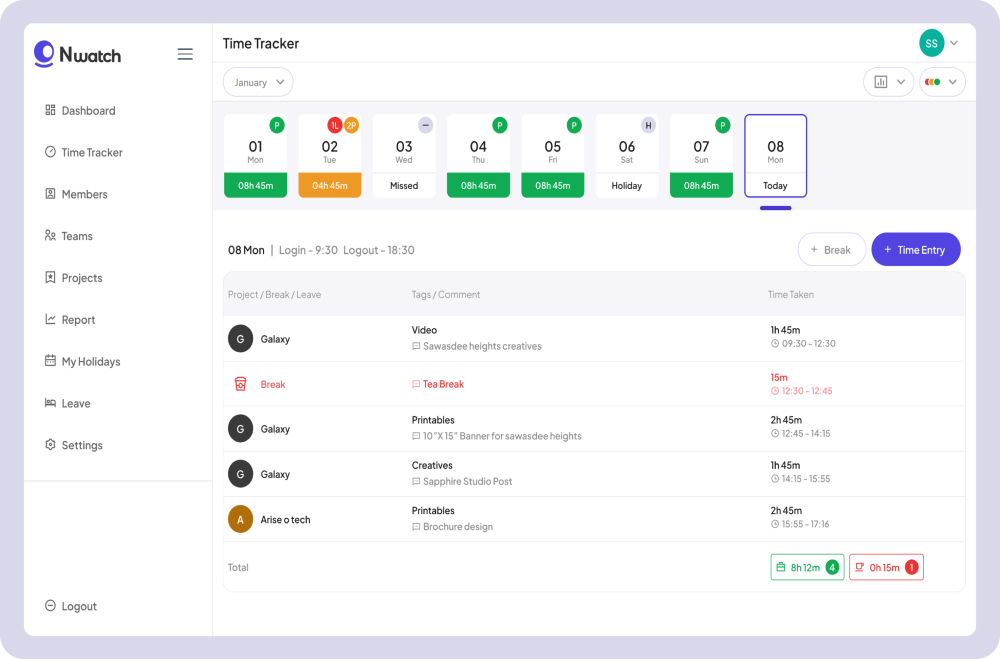
A. Time Tracking System
Real-Time Productivity Monitoring & Attendance Governance
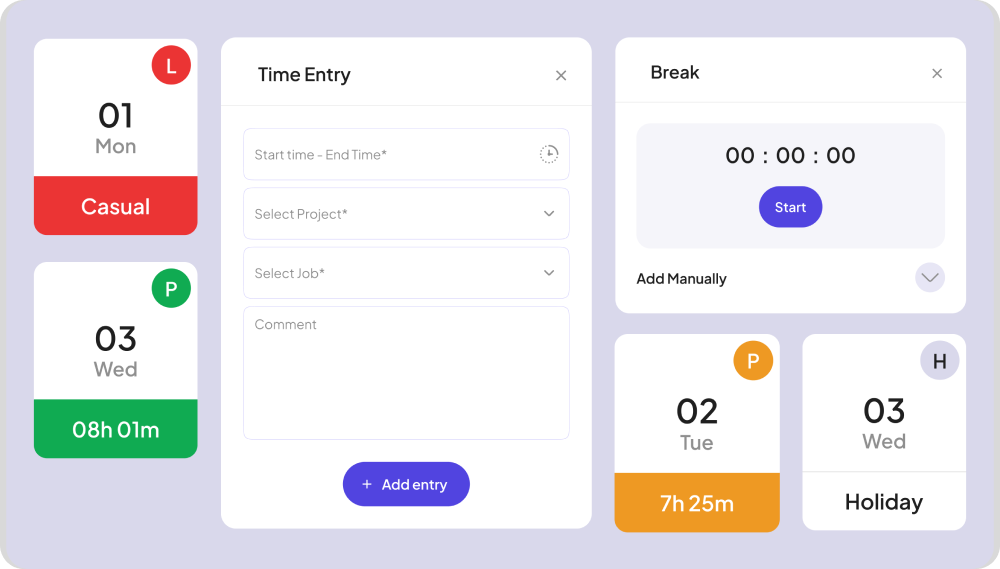
A real-time time tracking engine was developed to allow employees to log working hours, monitor attendance, and regulate break durations with precision. The goal was to shift from assumption-based productivity to measurable accountability.
This system introduced operational discipline without creating friction. Employees gained clarity over their own work patterns, while managers received structured visibility into time allocation across projects.
Key Capabilities
- Live time logging and attendance capture
- Break duration monitoring
- Role-based dashboard access
- Daily and project-level time summaries
Problems Solved
- Accurate tracking of billable hours
- Improved daily work discipline
- Clear visibility into productivity consistency
- Structured attendance monitoring
By introducing structured time tracking, we converted daily activity into actionable productivity data.
B. Reporting Engine
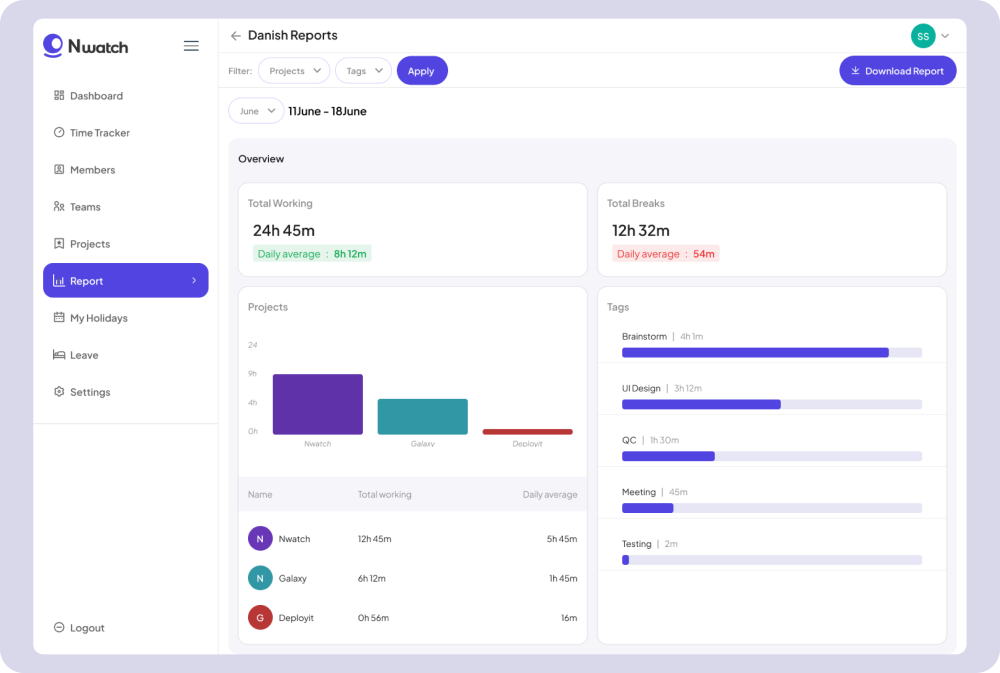
Intelligent Reporting & Billing Transparency
The reporting engine was designed to transform operational data into strategic insight. Instead of manually compiling spreadsheets, managers could now generate structured reports instantly.
This module became the bridge between internal productivity and external accountability. It ensured that client-facing reports were accurate, structured, and audit-ready.
Key Capabilities
- Automated billable hour reports
- Custom project and date-level filters
- One-click Excel exports.
- Performance analytics dashboards
- Team productivity summaries
Problems Solved
- Eliminated manual report compilation.
- Reduced billing discrepancies
- Enabled data-driven performance reviews
- Increased client transparency
The reporting system strengthened operational credibility while reducing administrative workload.
C. Leave Management Module
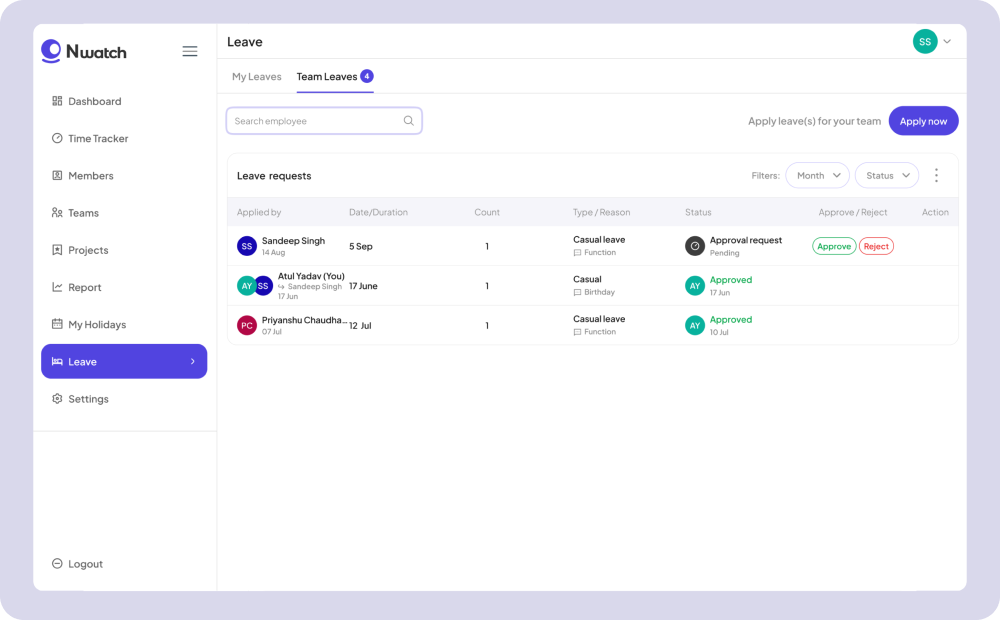
Automated Workforce Planning & Absence Control
Manual leave approvals were replaced with a structured digital workflow, ensuring better coordination and visibility across teams.
This module reduced unpredictability in workforce planning and helped teams avoid overlapping absences during critical project timelines.
Key Capabilities
- Digital leave application and approval system
- Emergency leave processing
- Shared team calendar visibility
- Holiday configuration management
Problems Solved
- Reduced leave conflicts
- Improved project resource planning
- Eliminated manual tracking errors
- Enhanced operational predictability
By formalizing leave management, Nwatch ensured smoother project continuity and better team coordination.
D. Additional Operational Infrastructure
Scalable Administrative Controls
To ensure long-term scalability, we integrated operational controls that support growing teams and evolving workflows. The platform was built with flexibility at its core, allowing new projects, users, and policies to be configured without structural changes.
Functional Enhancements
- Project creation and allocation system
- Team onboarding workflows
- Yearly holiday configuration
- Advanced Role-Based Access Control (RBAC)
These enhancements elevated Nwatch from a productivity tracker to a complete workforce management platform.
E. Design System & UX Framework
Structured Product Architecture for Scale
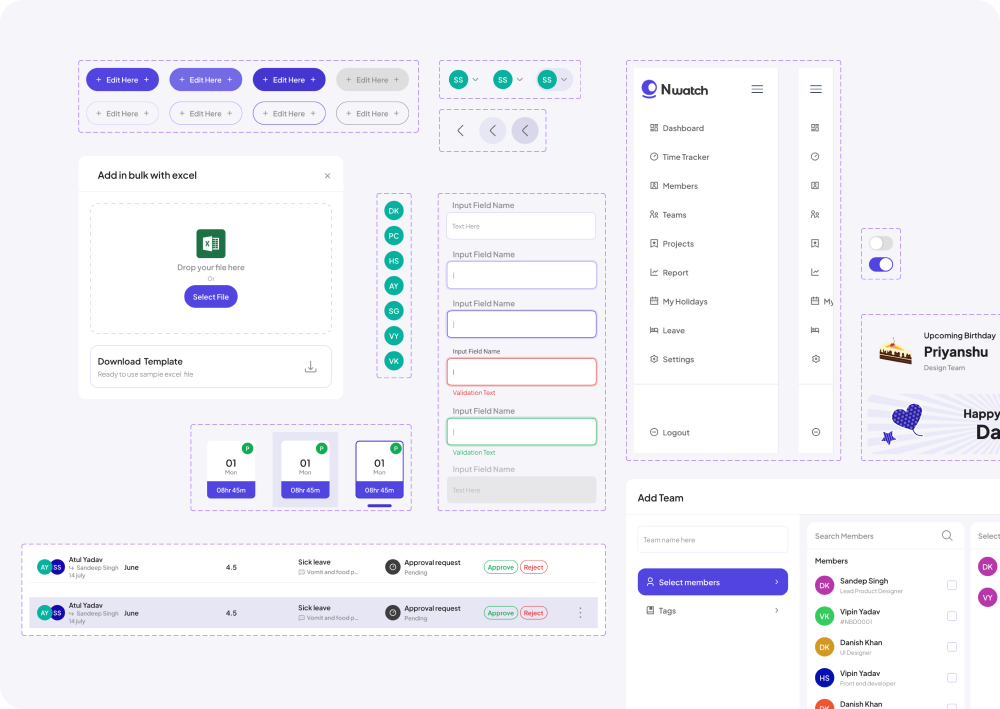
Before development began, a comprehensive design system was established to maintain visual consistency and accelerate iteration cycles.
The product needed to be intuitive for employees while offering structured visibility for managers. The design language was therefore clean, functional, and data-centric.
System Components Included
- Reusable UI components
- Modular dashboard layouts
- Standardized color system
- Structured typography guidelines
- Consistent interaction patterns
The impact
The implementation of Nwatch delivered measurable operational improvements while also creating long-term structural and cultural benefits. The impact can be understood across both quantitative performance metrics and qualitative organizational transformation.
A. Quantitative Impact
1. Productivity & Work Consistency
- 35–45% improvement in daily time logging consistency
- 25–30% reduction in untracked work hours
- 40% faster visibility into underperforming tasks
2. Reporting & Billing Efficiency
- 90% reduction in manual reporting effort
- Report generation time reduced from hours to minutes
- 100% structured tracking of billable hours
3. Leave & Attendance Management
- 60% reduction in leave overlap conflicts
- 50% faster leave approval turnaround
- Complete elimination of manual leave tracking errors
4. Delivery Performance
- 30% improvement in on-time task completion
- Noticeable reduction in project delays within the first 30 days

B. Qualitative Impact
1. Improved Operational Discipline
Employees became more conscious of how they allocate their time. Structured logging created accountability without increasing managerial pressure.
2. Data-Driven Decision Making
Leadership discussions shifted from assumptions to performance-backed insights. Managers could proactively identify bottlenecks instead of reacting after delays occurred.
3. Transparency Across Hierarchy
strategic visibility, managers accessed team-level data, and employees monitored personal performance.
4. Cultural Shift Toward Self-Assessment
The platform encouraged employees to evaluate their own productivity patterns. Over time, this created a culture of ownership and performance awareness.
5. Scalable Operational Infrastructure
Nwatch evolved from an internal productivity fix into a scalable SaaS framework. New teams, projects, and clients can now be onboarded within a structured operational environment.
Conclusion
Nwatch transformed fragmented time tracking and reporting processes into a unified, scalable SaaS platform that improved productivity visibility, billing accuracy, and leave management efficiency. By centralizing operations into a structured system, the organization eliminated manual inefficiencies, enhanced accountability, and built a reliable foundation for long-term operational growth.